[ MODEL-SPECIFIC NETWORK HARDWARE RECORD ]
Cisco QSFP-40G-SR4 40GBASE-SR4 QSFP+ Transceiver
Parallel 850nm 40GbE QSFP+ optic with MPO-12 multimode interface. Exact PID, host qualification and optical channel specifications should be checked before deployment.
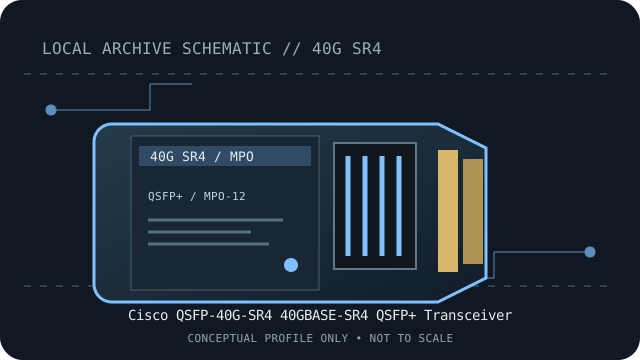
IDENTIFICATION: Match the module label, vendor part number and revision to the manufacturer's documentation. Nominal link rate and maximum reach are specifications, not measured throughput or a guarantee for every installed channel.
Model-specific specifications and compatibility
| Subcategory | SFP transceivers: optical and copper |
|---|---|
| Exact product/model | Cisco QSFP-40G-SR4 40GBASE-SR4 QSFP+ Transceiver |
| Form factor | QSFP+, hot-pluggable four-lane 40GbE transceiver. |
| Optical interface | 40GBASE-SR4; four parallel optical lanes centered at 850nm, for a nominal aggregate 40Gb/s. |
| Nominal rate (not measured) | 40Gb/s aggregate Ethernet rate (four-lane parallel optical interface). |
| Wavelength and reach | Up to 100m on OM3 or 150m on OM4 multimode fiber per Cisco’s 40G QSFP data sheet. |
| Connector and fiber type | MPO-12/MTP-compatible parallel connector; multimode fiber (MMF). |
| Host coding and compatibility caveat | Requires a 40GbE QSFP+ port that supports Cisco PID QSFP-40G-SR4. Validate switch/router model, port mode and software in Cisco’s transceiver matrix. Parallel SR4 is not a duplex-LC optic; breakout cabling, polarity and remote-end lane arrangement must match the specific design. |
| Variant / deployment caveat | Keep MPO polarity and lane mapping correct. A physical QSFP+ cage or a four-lane breakout does not ensure the host supports the intended 40GbE or breakout mode. |
| Measured throughput | No bench result is claimed. Actual payload throughput depends on the host, link partner, protocol overhead and test method. |
Host qualification and installation notes
Requires a 40GbE QSFP+ port that supports Cisco PID QSFP-40G-SR4. Validate switch/router model, port mode and software in Cisco’s transceiver matrix. Parallel SR4 is not a duplex-LC optic; breakout cabling, polarity and remote-end lane arrangement must match the specific design.
Keep MPO polarity and lane mapping correct. A physical QSFP+ cage or a four-lane breakout does not ensure the host supports the intended 40GbE or breakout mode.
Check both endpoint modules, fiber grade, polarity, connector cleanliness and host port configuration. Verify the exact transceiver PID and revision against the current manufacturer compatibility source before placing the link in service.
Archival, ESD and fiber-safety notes
Record the exact PID, hardware revision, host port, firmware/software release and available digital optical diagnostics. Store the module in ESD-safe packaging with dust caps fitted. Never look into an active fiber or transceiver aperture.
Manufacturer sources
- Cisco 40GBASE QSFP Modules Data SheetCisco 40GBASE QSFP+ module specifications, including SR4.
- Cisco Transceiver Module Group (TMG) MatrixCisco host-platform, software-release and transceiver PID qualification lookup.
Manufacturer compatibility varies by host, release, module coding and product revision. Consult the exact product source and current host qualification before use.