[ MODEL-SPECIFIC OPTICAL NETWORK HARDWARE ]
Cisco QSFP-100G-SR4-S 100GBASE-SR4 QSFP28 Transceiver
850nm parallel-optics 100GbE QSFP28 for short multimode-fiber links. Confirm exact module label and host qualification before installation.
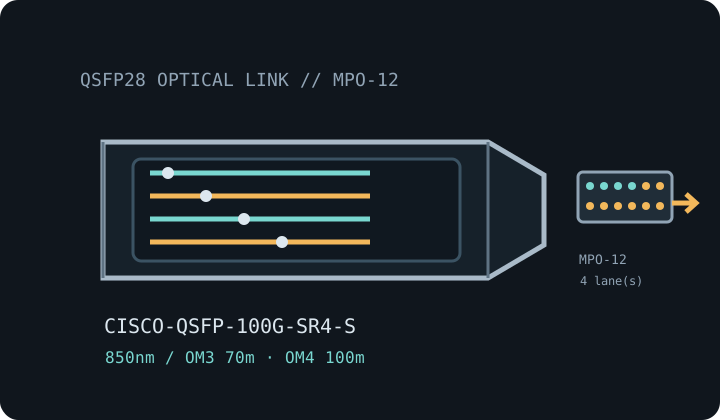
IDENTIFICATION: Match the manufacturer name, exact PID/suffix and revision to the host compatibility listing. Stated line rate and maximum reach are specifications, not measured payload performance.
Model-specific specifications
| Dedicated subcategory | SFP transceivers: optical and copper |
|---|---|
| Exact model / ordering SKU | Cisco QSFP-100G-SR4-S |
| Form factor and optical type | QSFP28 hot-pluggable four-lane parallel optical module; 100GBASE-SR4. |
| Ethernet rate and interface | 100GBASE-SR4 / 100GbE nominal aggregate rate (4 × 25Gb/s lanes). |
| Wavelength | 850nm nominal across the four parallel lanes. |
| Fiber medium and reach | Multimode fiber: up to 70m on OM3 or 100m on OM4 per Cisco specification. |
| Connector | MPO-12 (parallel multimode fibers); observe polarity and fiber mapping. |
| DOM / DDM | DOM supported; diagnostics and lane alarms depend on host implementation. |
| Operating temperature | Commercial operating case temperature: 0°C to 70°C. |
| Host switch/router compatibility | Confirm the exact SR4-S PID and QSFP28 port support in Cisco TMG. Host lane breakout, FEC and MPO polarity/cable mapping must match both ends; use qualified OM3/OM4 plant and do not confuse parallel MPO SR4 with duplex-LC LR4/CWDM4. |
| Variant and deployment caveat | The SR4-S is an S-Class qualified variant. Do not infer host support from cage fit, or substitute LR4/CWDM4 modules with different media and connectors. |
| Measured performance | No measured specimen throughput is claimed; link payload depends on both host ports, FEC, coding, protocol overhead, fiber plant and test method. |
Host qualification and installation
Confirm the exact SR4-S PID and QSFP28 port support in Cisco TMG. Host lane breakout, FEC and MPO polarity/cable mapping must match both ends; use qualified OM3/OM4 plant and do not confuse parallel MPO SR4 with duplex-LC LR4/CWDM4.
The SR4-S is an S-Class qualified variant. Do not infer host support from cage fit, or substitute LR4/CWDM4 modules with different media and connectors.
Clean and inspect fiber end faces, retain dust caps during storage, follow ESD precautions, and never look into an active optical port. Record the host model, port, software release, transceiver label and available DOM values when documenting a deployed link.
Manufacturer and standards sources
- Cisco 100GBASE QSFP-100G Modules Data SheetCisco’s 100G QSFP datasheet covers SR4-S; Cisco TMG provides product- and host-specific qualification.
- Cisco Transceiver Module Group (TMG) compatibility matrixManufacturer lookup for transceiver PID, supported host platforms and software releases; confirm this exact labeled variant.
- IEEE 802.3 Ethernet standards familyEthernet PHY terminology and link-rate context; MSA-specific optics remain subject to their named module-family specifications.
Source links identify manufacturer documentation and qualification resources. Check the current documentation revision and exact hardware PID before deployment.