[ INDIVIDUAL COMPONENT // MOTHERBOARDS ]
ASUS ROG CROSSHAIR X870E HERO
AMD X870E Socket AM5 retail motherboard, 2024. This record describes only the named model; confirm the printed model, revision and firmware on the physical board.
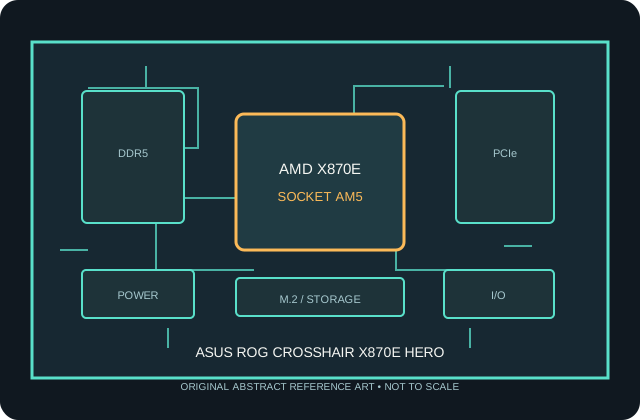
MODEL / REVISION WARNING: Similar names, Wi-Fi variants and PCB revisions can differ in wireless hardware, connectors, lane routing and firmware. Identify the exact model and revision before installation or BIOS updates.
Specifications
| Model / chipset | ASUS ROG CROSSHAIR X870E HERO — AMD X870E, 2024 |
|---|---|
| Socket / processor compatibility | Socket AM5 with X870E chipset. Ryzen 7000/8000G/9000 desktop CPU support is model- and BIOS-specific; select CPU and firmware from the current ASUS list before assembly. |
| Memory | Four DDR5 DIMM sockets in dual-channel mode with EXPO; supported capacity and overclocked rates vary with CPU, BIOS and validated memory population. Follow ASUS's QVL. |
| Form factor | ATX (305 × 244 mm) |
| PCI Express expansion | CPU-connected graphics expansion uses PCIe 5.0 x16 capability, with lane allocation shared between x16-length slots when multiple CPU lanes are assigned; chipset expansion is at reduced width. Check exact manual tables. |
| Storage | Multiple onboard M.2 sockets support PCIe 5.0 and PCIe 4.0 x4 NVMe devices, plus SATA 6 Gb/s ports; high-speed M.2 use may share lanes with graphics slots. Refer to the X870E HERO manual for per-socket rules. |
| Rear I/O | Rear USB4 40Gb/s Type-C ports, additional USB Type-A/Type-C, HDMI, high-speed wired networking, Wi-Fi antenna connectors, audio and BIOS FlashBack / clear-CMOS controls. |
| Networking / audio | Integrated Wi-Fi 7 / Bluetooth and 5Gb Ethernet (check regional product specification); onboard multichannel audio. |
| Firmware / compatibility | UEFI support, CPU list and minimum BIOS are model-specific. AM5 uses DDR5 only. Match the case to the stated board dimensions, use the correct EPS/ATX power leads, install the AM5 cooler with its supported mounting hardware, and check the manual's lane-sharing/connector tables before populating M.2 and PCIe devices. |
Compatibility notes
AM5 processors are not interchangeable with AM4 CPUs. Consult the manufacturer's CPU support list for the exact board and verify the required BIOS before purchasing or installing a processor. A BIOS flash utility does not make an unlisted CPU compatible.
DDR5 EXPO profiles are memory overclocking; stability, capacity and transfer rate depend on the CPU memory controller, DIMM type/population, firmware and the board's validated memory list. Storage protocols, expansion-slot widths, graphics lane reduction, SATA disablement and USB functionality depend on the connector and lane-sharing rules described in the current manual.
Confirm the physical dimensions and standoff layout against the chassis, install only the correct AM5 cooler hardware, connect required CPU power leads, and use the supplied Wi-Fi antenna where fitted. Firmware updates must match this exact model/revision and follow the manufacturer's procedure.
Preservation and handling
AM5 is an LGA socket: protect its exposed contacts from handling damage and contamination. Before installation, inspect the socket, DIMM slots, M.2 thermal pads, rear-I/O shield and power connectors. Record PCB revision, serial/date codes and BIOS version; retain the original packaging and document test conditions and any repairs.
Manufacturer sources
- ASUS ROG CROSSHAIR X870E HERO — product and specificationsManufacturer-provided model reference; use this resource to confirm specifications and model-specific support.
- ASUS ROG CROSSHAIR X870E HERO — support, manuals and firmwareManufacturer support page for the exact model; verify the CPU table and BIOS revision before installation.
Static summary for identification; manufacturer's documentation is authoritative. Confirm current CPU support, BIOS, memory population and resource sharing for the exact physical board.