[ INDIVIDUAL COMPONENT // TRUSTED COMPUTING ]
ASUS TPM-L R2.0
ASUS discrete TPM 2.0 motherboard module in the TPM-L form. This listing treats it separately from TPM-M R2.0 because connector geometry and host-board support are not interchangeable assumptions.
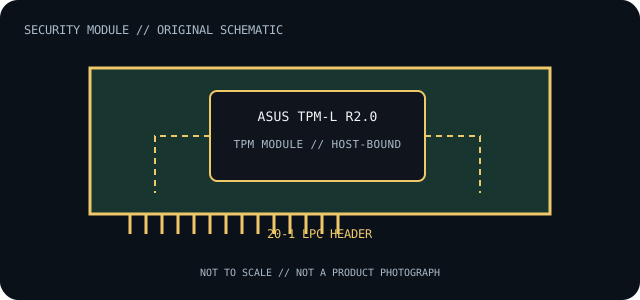
IDENTIFICATION: Confirm the printed part number, revision and host-board model. The connector, TPM generation, protocol transport and firmware support below are separate compatibility constraints.
Specifications and compatibility limits
| Catalog subcategory | Security coprocessors |
|---|---|
| Exact model / part identifier | TPM-L R2.0 |
| TPM protocol / command interface | TCG TPM 2.0 command interface through the LPC host connection; command availability is governed by the TPM profile, board firmware and OS stack. |
| Physical connector / transport | 20-1 pin LPC-style module connector. Match the exact header keying, pinout and voltage requirements from the ASUS motherboard documentation; do not substitute a TPM-M 14-1 module. |
| Host compatibility limit | Restricted to ASUS host boards whose manuals/support records identify TPM-L R2.0 or its matching 20-1 pin TPM header and firmware support. A 20-1 header on a different vendor’s board is not sufficient proof of fit or pin compatibility. |
| Firmware / OS compatibility limit | TPM 2.0 services require host BIOS/UEFI configuration and an OS TPM 2.0 stack. Supported firmware and security-policy behavior depend on the board; use only ASUS-documented update or recovery procedures. |
Installation, firmware and archival notes
- Before installation, record the module label/revision, host motherboard or server model, board revision, BIOS/UEFI version and TPM mode. Check the host’s own support list and installation diagram.
- Use ESD precautions and the documented module orientation. A physically fitting header may have different LPC/SPI signaling, pinout or voltage; never hot-plug a motherboard TPM module.
- TPM clear, replacement, firmware changes or mode changes can invalidate keys sealed to the previous TPM state. Back up recovery keys and follow the platform owner’s documented recovery procedure before service.
- This is a TPM, not a general-purpose cryptographic coprocessor or HSM: do not assume it offers PCIe/USB/network connectivity or vendor-specific bulk crypto APIs.
Where a manufacturer no longer publishes a current manual, preserve the source revision and verify the hardware against the original host platform before use.
Manufacturer and standard sources
- ASUS — TPM-L R2.0 manual and support downloadsManufacturer documentation for module identification and host/platform limitations.
- ASUS — TPM-M versus TPM-SPI compatibility and supported-product guidanceSeparate ASUS compatibility reference for choosing the correct module family and supported host.
- TCG — TPM 2.0 Library SpecificationStandards reference for the TPM generation and command model; it does not certify this module’s electrical or platform compatibility.
Source scope is explicit: manufacturer documents identify the part and host constraints; TCG documentation defines protocol generation. Standards compliance does not guarantee a particular board/firmware combination.