[ SERVER CPU // ZEN NAPLES // 2017 ]
AMD EPYC 7551P
1st Generation EPYC 7000 Series / Naples; 32 cores / 64 threads, 2.0 GHz base / up to 3.0 GHz boost, 64 MB L3, 180 W TDP, SP3, 8-channel DDR4-2666 ECC, 128 lanes PCIe 3.0. Match the exact SKU and generation to the server platform before service or deployment.
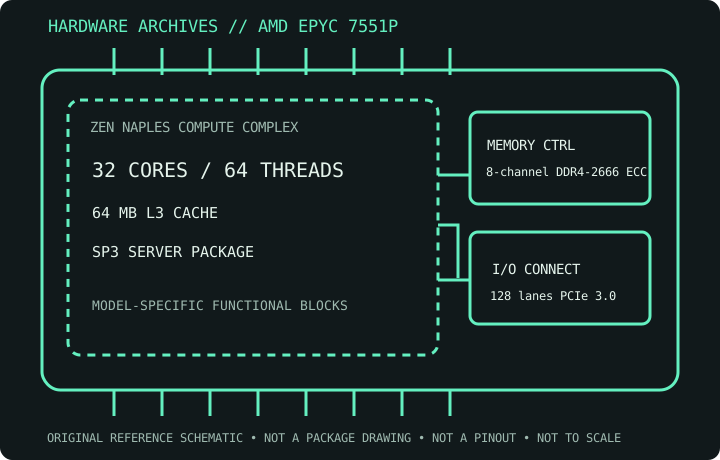
MODEL IDENTIFICATION: This record describes AMD EPYC 7551P. Verify the complete model name, suffix and package marking against the cited AMD specification and the platform manufacturer’s documentation; related EPYC SKUs can differ in core count, power, socket support or multiprocessor capability.
Recorded specifications
| Cataloged model | AMD EPYC 7551P |
|---|---|
| Generation / microarchitecture | 1st Generation EPYC 7000 Series / Naples; Zen CPU cores. |
| Core / thread count | 32 cores / 64 threads |
| Frequency | 2.0 GHz base / up to 3.0 GHz max boost |
| Cache | 64 MB L3 |
| Thermal design power | 180 W TDP (published nominal processor rating) |
| Socket / package | SP3 |
| Memory | 8-channel DDR4-2666 ECC; verify supported DIMM type, rank and capacity in the server QVL. |
| PCI Express | 128 lanes PCIe 3.0 |
| Socket scaling | 1P only (P-series single-socket SKU) |
Server-platform compatibility
Single-socket SP3 servers designed and validated for first-generation EPYC 7000 processors. Use a Naples-capable board/firmware, 180 W-rated cooling and power delivery, and populate all eight memory channels with supported ECC registered DIMMs.
- Confirm the exact processor SKU appears on the system or motherboard manufacturer’s CPU support list, with the required BIOS/AGESA version and board revision.
- Check package/carrier, cooling and chassis air path, power delivery, memory QVL and channel population, firmware, and permitted socket configuration. Shared socket names do not establish generation or system compatibility.
- Before handling, follow the server vendor’s service procedure and use the correct carrier, socket tool and torque sequence. Record OPN, stepping, firmware, DIMM population and thermal configuration for archival testing.
Sources & further reading
- AMD — AMD EPYC 7551P product specificationsManufacturer model reference for SKU-specific specifications. Match the complete part number and product revision when checking fit.
- AMD — Processor specifications catalogAMD manufacturer catalog for cross-checking product-family specification data against the exact model.
- AMD EPYC 7000 Series Product BriefAMD manufacturer generation/family material for architecture and platform context; use the model specification and system-vendor support list for final configuration.
- AMD — Support and documentationOfficial AMD documentation and support entry point. Server motherboard and system-vendor CPU support lists remain authoritative for host compatibility.
- Various Creators — AMD EPYC 7551P Performance TestIndependent video review; treat as supplementary context, not primary manufacturer documentation.
Maximum boost is a peak operating specification, not a guaranteed sustained all-core frequency. Actual operation depends on cooling, firmware, workload and the server vendor’s configured limits.