
Specific allegation
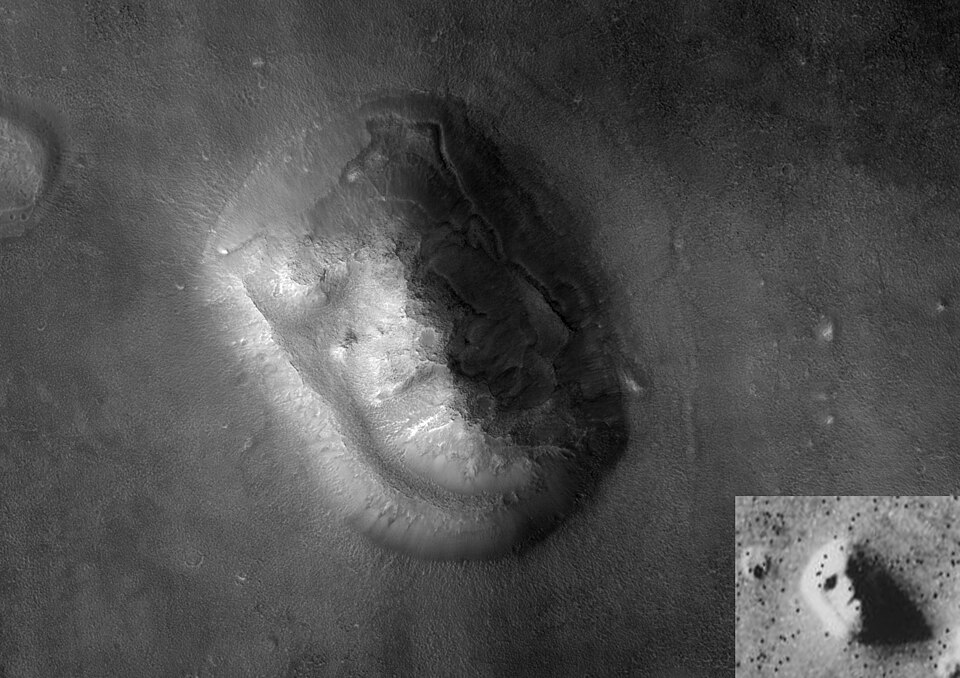
A Cydonia mesa looked face-like in one Viking image, prompting claims it is an artificial monument and that agencies hid its true shape. A constructed face predicts symmetry and geometry that should survive higher resolution and changed lighting; it can be compared with public spacecraft images.
Chronology and context
Viking 1 photographed the region in 1976 at limited resolution and low-angle illumination. Mars Global Surveyor, Mars Express, and later orbital cameras returned clearer views. The mesa’s apparent face weakened as resolution and viewing geometry improved; popular crops often enhanced contrast.
Observations and physical record
The original and later images are public. Stereo topography shows irregular natural relief; no tool marks, architectural pattern, construction debris, or material boundary has been found. The impression depends on shadows and scale, and varies with illumination rather than persisting as a designed three-dimensional form.
Established scientific account
Erosion and impact geology produce irregular mesas on Mars. Low Sun angles create shadows that can resemble facial features, and pareidolia encourages recognition of familiar patterns. Higher-resolution images reveal asymmetry and surrounding natural terrain, not a monument or city.
Limits and contrary evidence
No rover has sampled this mesa, and imagery cannot exclude every archaeological possibility elsewhere. But this claim predicts artificial geometry at the feature already imaged; existing data instead show natural morphology. Uncertainty about life on Mars does not validate a particular monument claim.
What could change the assessment
Publish coordinates and calibrated stereo images showing engineered symmetry beyond natural landform patterns. The alleged form should persist under varied lighting and independent cameras. Raw data should be analyzed blind; a future sample might refine composition but is not needed to assess the existing shape.
The same landform can look face-like under low illumination and ordinary under another angle because shadows encode relief. Public stereo and repeat images are therefore more probative than resemblance in one frame. The evidence bears on this named mesa only and does not settle unrelated questions about ancient Martian habitability.
Calibrated conclusion
The Cydonia “face” is a natural mesa whose early appearance was amplified by lighting and low resolution. Public imagery contradicts a hidden monument.
Sources and scope
- NASA Viking missionOriginal image context and mission archive.
- ESA Mars ExpressIndependent later high-resolution views.
- NASA Mars Reconnaissance OrbiterRepeated imaging resolves terrain and topography.