DOSSIER A42-02 // LUNAR EXPLORATION
“The Moon landings were staged”
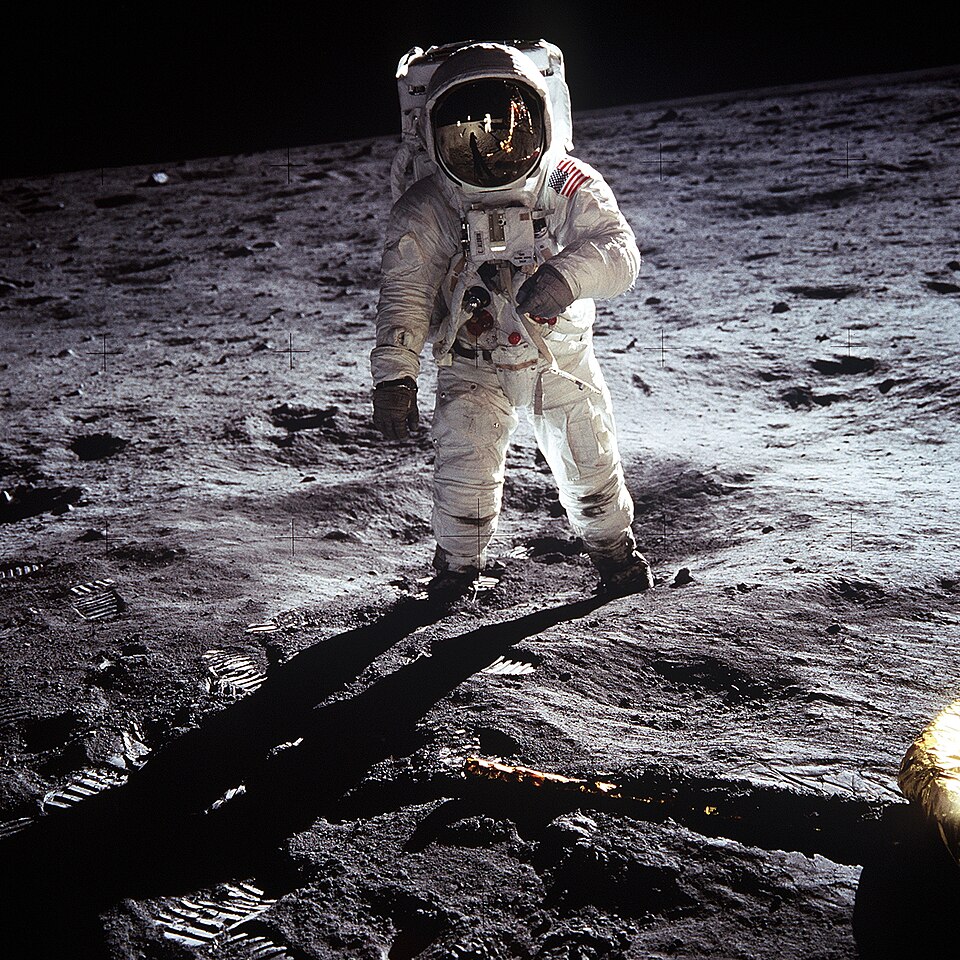

Creator: Neil A. Armstrong. License: Public domain.
A documented Apollo 11 surface photograph; it is historical context, not a substitute for the mission’s wider evidence record.
The claim
Apollo missions allegedly never landed people on the Moon; photographs, shadows, flags, radiation, or video are presented as signs of a studio production.
What the record supports
The Apollo missions are supported by extensive engineering and mission records, tracking, returned lunar samples, independent observations, and hardware left on the lunar surface. Individual photographs can be confusing without understanding exposure, perspective, reflectance, and the lunar environment.
Assessment: The hoax claim conflicts with multiple independent lines of physical and historical evidence. Common photo “anomalies” are not evidence of staging unless a proposed explanation survives the full photographic and engineering context.
Useful checks
- Check whether a claim predicts a measurable result that differs between a landing and a studio simulation.
- Compare complete mission photography and transcripts rather than isolated, context-free images.
- Distinguish the documented Apollo landings from reasonable debate about program cost, risk, politics, and individual mission details.
- NASA — Apollo landing sitesLunar reconnaissance imagery of Apollo sites and hardware.
- NASA Johnson Space Center — Apollo lunar sample collectionCatalog and scientific context for returned lunar samples.
- NASA History OfficeMission histories, documents, and primary-source archives.
Multiple lines of verification
The landing record does not rest on a single NASA photograph or one agency's retrospective account. Mission communications and tracking, hardware and samples returned to Earth, contemporaneous observations outside the United States, and later orbital images of landing-site equipment form different evidence streams. Each has its own limitations; their value comes from consistency and partial independence, not from treating any one artifact as unchallengeable.
Common visual objections need to be tested against camera exposure, perspective, lighting, and the actual lunar surface. A shadow that looks unusual in a cropped image is not by itself a falsifiable demonstration of a studio set. A serious alternative would need to explain the engineering, tracking, sample chemistry, and later observations together, with evidence that discriminates between a landing and a fabrication.