A42-POL-019 // HISTORICAL CLAIM REVIEW
The Gunpowder Plot of 1605
Assessment: A real and dangerous conspiracy was organized by a small Catholic group.
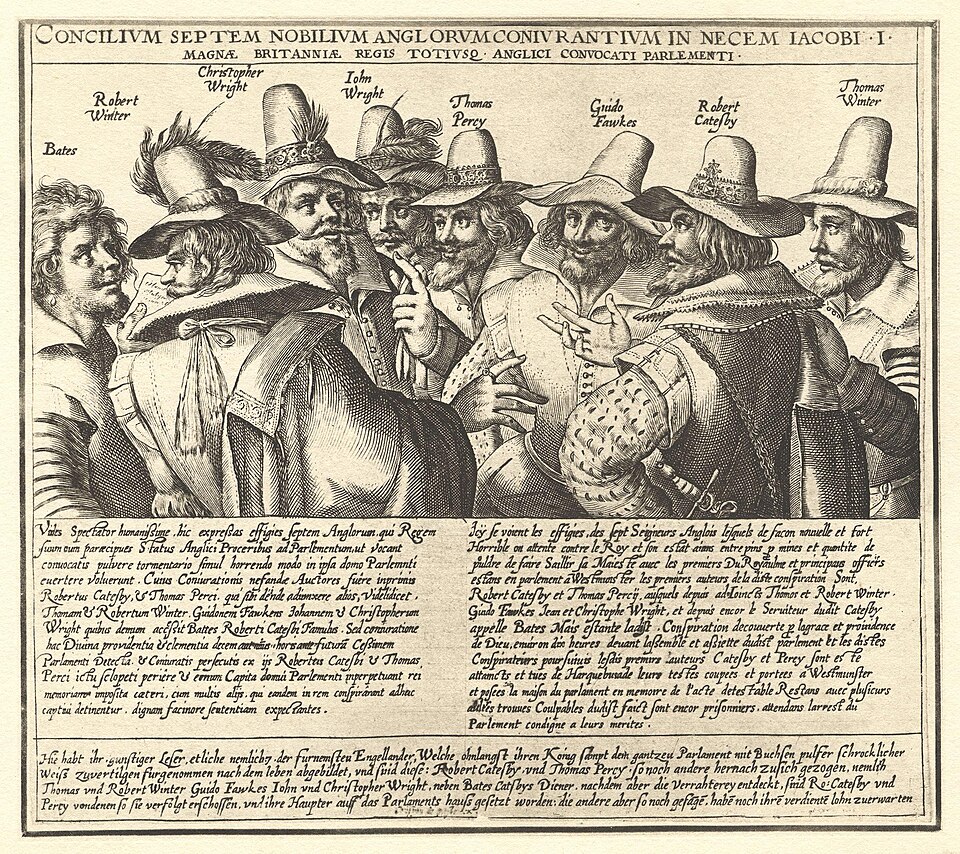

The precise allegation
A group of English Catholics conspired to blow up Parliament and kill James I, his family, and much of the political elite. The conspiracy and Guy Fawkes's role are documented. Debate centers on the government's use of informants, the timing of the warning, and whether authorities allowed the plot to proceed to expose or punish Catholic opponents; those suspicions do not erase the plot itself.
Chronology and political context
The conspirators stockpiled gunpowder beneath the House of Lords and planned to act at the State Opening on November 5, 1605. An anonymous letter led officials to search the cellar and find Fawkes. Arrests, interrogations under torture, trials, and executions followed. The plot arose amid anti-Catholic restrictions and failed hopes that James would ease religious penalties.
Primary historical record
The official examinations, trial proceedings, state correspondence, and surviving gunpowder-era proclamations establish the conspiracy. Confessions were extracted under torture and shaped by government priorities, so they cannot be treated as neutral. Later editions of official records permit scrutiny, but the original government had incentives to depict a broad Catholic threat.
Corroboration and contrary evidence
The conspirators' meetings, materials, and Fawkes's capture are corroborated by multiple contemporaneous sources. Historians differ over how much intelligence authorities had before the letter and whether informants manipulated events. The claim of a wholly fabricated plot is inconsistent with participant evidence, while the claim that officials exploited the discovery to strengthen repression is well grounded.
What remains uncertain
The anonymous letter's author, the precise extent of government foreknowledge, and the motives of every peripheral suspect remain uncertain. Torture limits the reliability of confessions, and the Crown controlled publication. The political aftermath widened anti-Catholic measures, but that consequence alone cannot prove the state arranged the explosion plan.
Calibrated verdict
A real and dangerous conspiracy was organized by a small Catholic group. Government handling and later propaganda deserve critical examination, yet a full state fabrication is not supported. The evidence best supports a genuine plot, opportunistic use of its discovery, and unresolved questions about informants and advance warning.
What evidence could change this assessment
A newly authenticated private letter revealing the informant chain or an instruction to conceal the plot until a chosen moment could change the foreknowledge assessment. Independent diaries or financial records linking suspected provocateurs to the conspirators would matter. The existence of the plot itself would require unusually strong evidence to overturn.
Sources and source limits
- UK Parliament — The Gunpowder PlotParliamentary historical overview and source links; an institutional summary rather than a neutral adjudication of every informant theory.
- The National Archives (UK) — Gunpowder Plot recordsUses primary records for educational interpretation; selected documents are not the entire surviving archive.
- Mark Nicholls, Investigating Gunpowder Plot (Manchester University Press)Scholarly study of evidence and government response; makes an interpretive argument grounded in a contested archive.